History of the Capitoline Museums: 1471 to Today
Trace the Capitoline Museums from the 1471 civic bronze donation to Michelangelo's piazza, the 1734 public opening, and modern expansion.
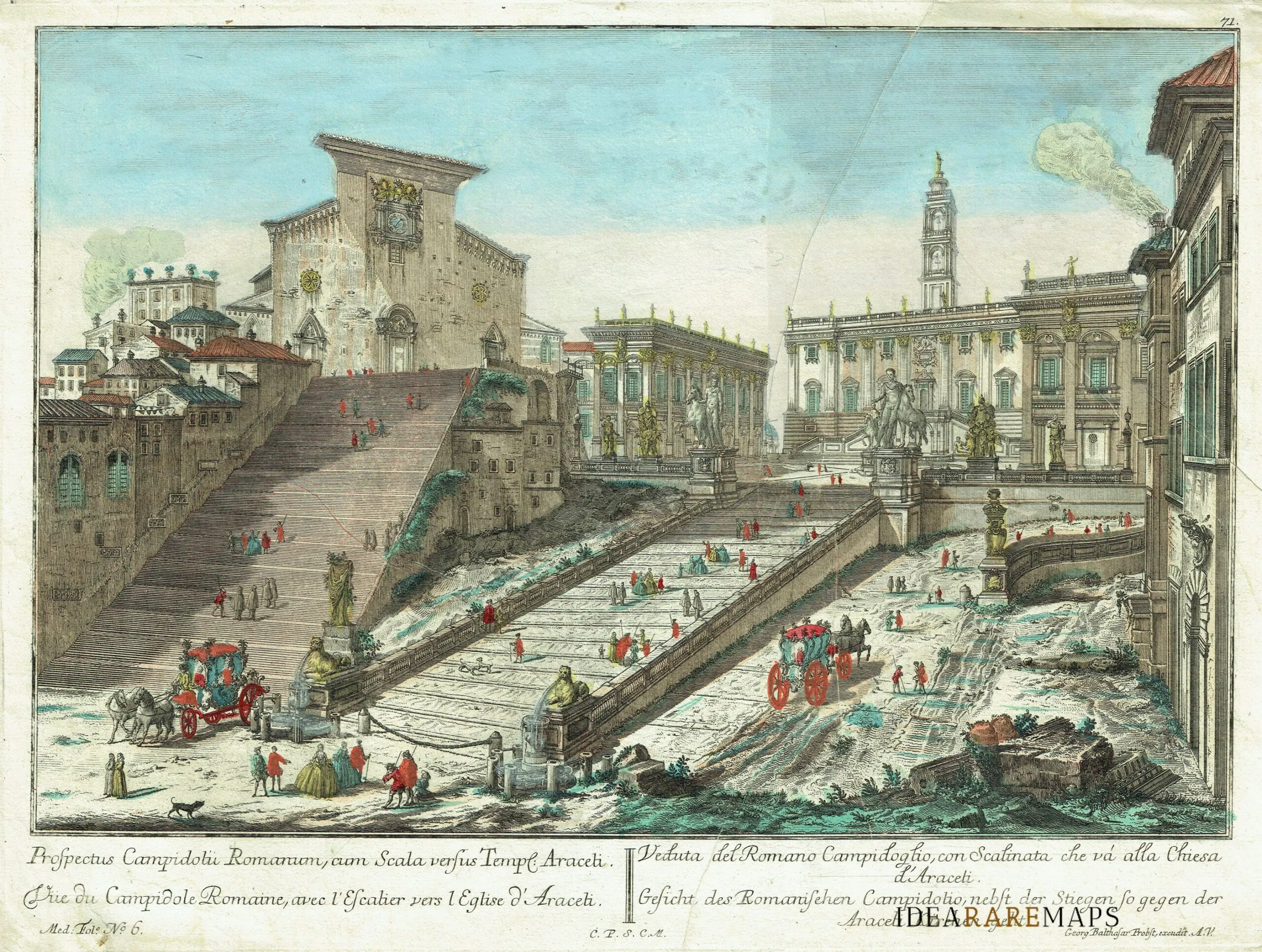
The Capitoline Museums did not begin as a conventional gallery. Their founding act was political, civic and symbolic: in 1471 Pope Sixtus IV gave a group of ancient bronzes formerly kept at the Lateran to the people of Rome. Displayed on the Capitoline Hill, these objects connected the papacy, the municipal government and the memory of ancient Rome.
The donation of 1471
The early group included the She-wolf, the Spinario and other celebrated bronzes. Their placement at the seat of Rome's civic government was significant. Antiquities that embodied the city's past were being returned, at least rhetorically, to its citizens. This moment is conventionally treated as the foundation of the Capitoline Museums.
The collection grew through further papal gifts. In 1566 Pius V transferred antiquities from the Vatican Belvedere, reinforcing the Capitol as a place where ancient sculpture could be studied and displayed.
Michelangelo reshapes the hill
By the sixteenth century, the medieval civic buildings on the summit lacked a unified setting. Pope Paul III asked Michelangelo to redesign the piazza and its architecture. The project turned the complex toward the city rather than toward the Roman Forum.
The ancient equestrian statue of Marcus Aurelius arrived from the Lateran in 1538 and became the centre of the design. Michelangelo planned new façades for Palazzo dei Conservatori and Palazzo Senatorio, a matching palace across the square, the cordonata and an oval pavement pattern. Construction continued long after his death; the star-patterned paving was not completed until 1940.
The birth of a public sculpture museum
Palazzo Nuovo was constructed in the seventeenth century to create the architectural balance Michelangelo had envisaged. A decisive collection arrived in 1733, when Pope Clement XII acquired 418 sculptures from Cardinal Alessandro Albani. Palazzo Nuovo opened to the public in 1734.
This opening is why the institution is often described as the world's oldest public museum, though such claims depend on definitions of public access and museum organisation. What is certain is that the Capitoline collection became an influential early model for the systematic public display of antiquities.
The Pinacoteca followed in the mid-eighteenth century, built around the Sacchetti and Pio di Savoia collections. It gave the civic museum a major painting collection alongside its antiquities.
A museum transformed by modern Rome
After Rome became the capital of unified Italy, rapid construction exposed ancient sculpture, inscriptions and architecture across the city. From 1876 onward the Capitoline displays expanded to absorb discoveries from new neighbourhoods and infrastructure projects. The Horti collections, including finds from luxurious ancient garden estates on the Esquiline, are products of this period of urban archaeology.
In the late 1930s, an underground gallery was created beneath the piazza to link the palaces. The Galleria Lapidaria eventually became a setting for Roman inscriptions and archaeological remains. It reopened in its present form in 2005 after a long closure.
Expansion beyond the hill
Renovation in the 1990s led to the temporary transfer of sculpture to the disused Centrale Montemartini power station. The contrast between ancient marble and industrial machinery proved so successful that Centrale Montemartini became permanent in 2001.
The main museum was renewed in 2005 with a glass Exedra for Marcus Aurelius, a new presentation of the Temple of Jupiter foundations, and reorganised archaeological collections. The result is a museum that continues to evolve while retaining rooms formed in the eighteenth century.
The institution's history is therefore not a straight line from ancient object to modern display. It is a sequence of civic decisions about ownership, urban identity and access. Every generation has rearranged the relationship between Rome's past and the city that surrounds it.
Σχετικά με τον συγγραφέα

Editorial Team
Ο ανεξάρτητος οδηγός βασίζεται σε επίσημες πληροφορίες και αξιόπιστες πολιτιστικές πηγές, με έλεγχο σαφήνειας και επισήμανση μεταβαλλόμενων στοιχείων.
Tags
Comments (0)
Loading comments...