Tabularium and Ancient Sites Beneath the Capitoline
Discover the Tabularium, Galleria Lapidaria, Roman Forum viewpoint, and Temple of Jupiter remains inside the Capitoline Museums.
The Capitoline Museums are often approached as art galleries, but some of their most important exhibits cannot be separated from the hill itself. Beneath and within the palace complex survive Republican masonry, ancient roads, inscriptions and the foundations of Rome's principal temple.
The Temple of Jupiter Optimus Maximus
Jupiter's temple dominated the ancient Capitol. Traditionally dedicated in 509 BC, it was shared by the Capitoline triad of Jupiter, Juno and Minerva. The enormous podium measured approximately 62 by 54 metres, making the sanctuary a statement of political as well as religious power.
Parts of the podium foundations are incorporated into the museum. In the area near the Marcus Aurelius Exedra, the massive blocks and full-height Roman wall make the building's scale more legible than a floor plan can. The remains are not decorative fragments moved from elsewhere; they occupy the terrain of the temple itself.
Successive fires and rebuildings altered the sanctuary in antiquity. What survives is therefore evidence of a long-lived sacred centre rather than a complete snapshot of one construction phase.
The Tabularium
Below Palazzo Senatorio stands the monumental structure traditionally identified as the Tabularium, completed under Quintus Lutatius Catulus in 78 BC. It is commonly described as Rome's public records office, although scholarship has debated aspects of its exact function.
The surviving vaulted gallery formed a commanding architectural backdrop to the Roman Forum. Medieval and later construction absorbed its upper levels into the civic palace above. Walking through it makes the vertical history of the hill tangible: Republican structure, medieval government seat and Renaissance façade occupy the same slope.
The Forum viewpoint
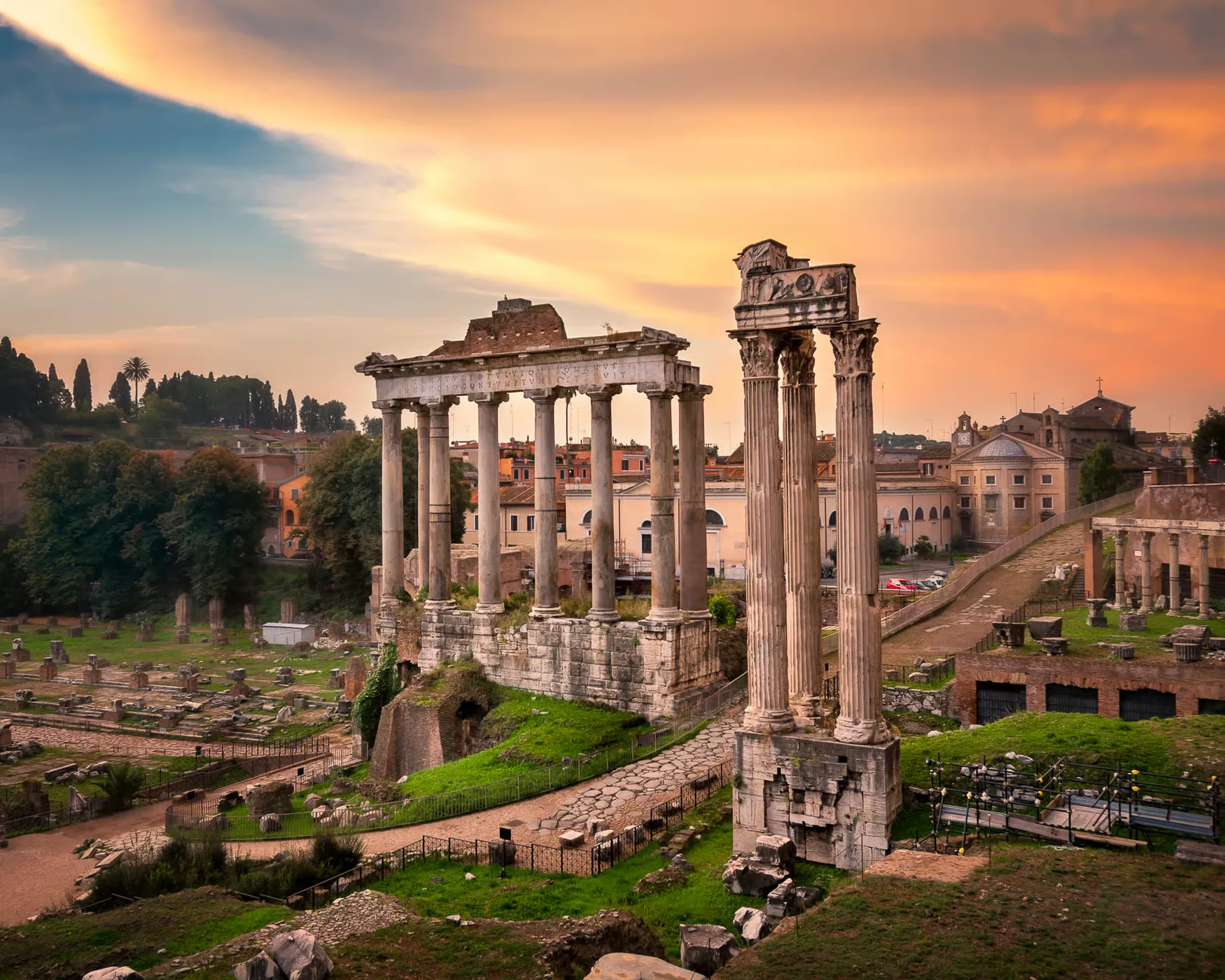
The opening from the Tabularium frames the Temple of Saturn, Arch of Septimius Severus and the Forum's layered ruins from above. It is more than a scenic stop. From this elevation, the relationship between the Capitol and the political-religious centre below becomes understandable.
Use the view to orient yourself rather than identifying every column. The Capitoline formed the elevated western boundary of the Forum; processions, triumphs and state ritual connected the spaces.
The Galleria Lapidaria
The underground passage beneath Piazza del Campidoglio links the museum palaces roughly eight metres below the square. Created in the twentieth century, it preserves sections of an ancient road and structures while displaying a selection of Roman inscriptions.
The 130 inscriptions currently presented are organised around themes including law, worship, occupations, military life, roads, burial and elite status. Read several complete translations. A funerary text naming age and family can recover an individual more directly than an idealised statue.
Epigraphy also exposes the administrative machinery of Rome. Dedicatory formulas, public decrees and military titles show how authority was recorded and made visible. Abbreviations that initially seem impenetrable become repeated patterns.
How to include the underground route
Do not leave the crossing until the final minutes of your visit. The gallery is both a connection and a collection, and the Forum view deserves an unhurried pause. Allow at least thirty minutes; epigraphy enthusiasts will need longer.
Together, the temple foundations, Tabularium and inscriptions change the museum's narrative. The Capitoline collection is not merely situated on an ancient hill. It is embedded in the surviving structures through which Rome organised religion, records, public memory and government.
Sobre el autor

Editorial Team
Guía independiente elaborada con información oficial y fuentes culturales fiables, señalando los datos que deben volver a comprobarse.
Tags
Comments (0)
Loading comments...