Capitoline Wolf: Meaning, History, and Dating Debate
Explore the Capitoline Wolf's role as Rome's emblem, the later twins, and the evidence behind competing ancient and medieval dates.
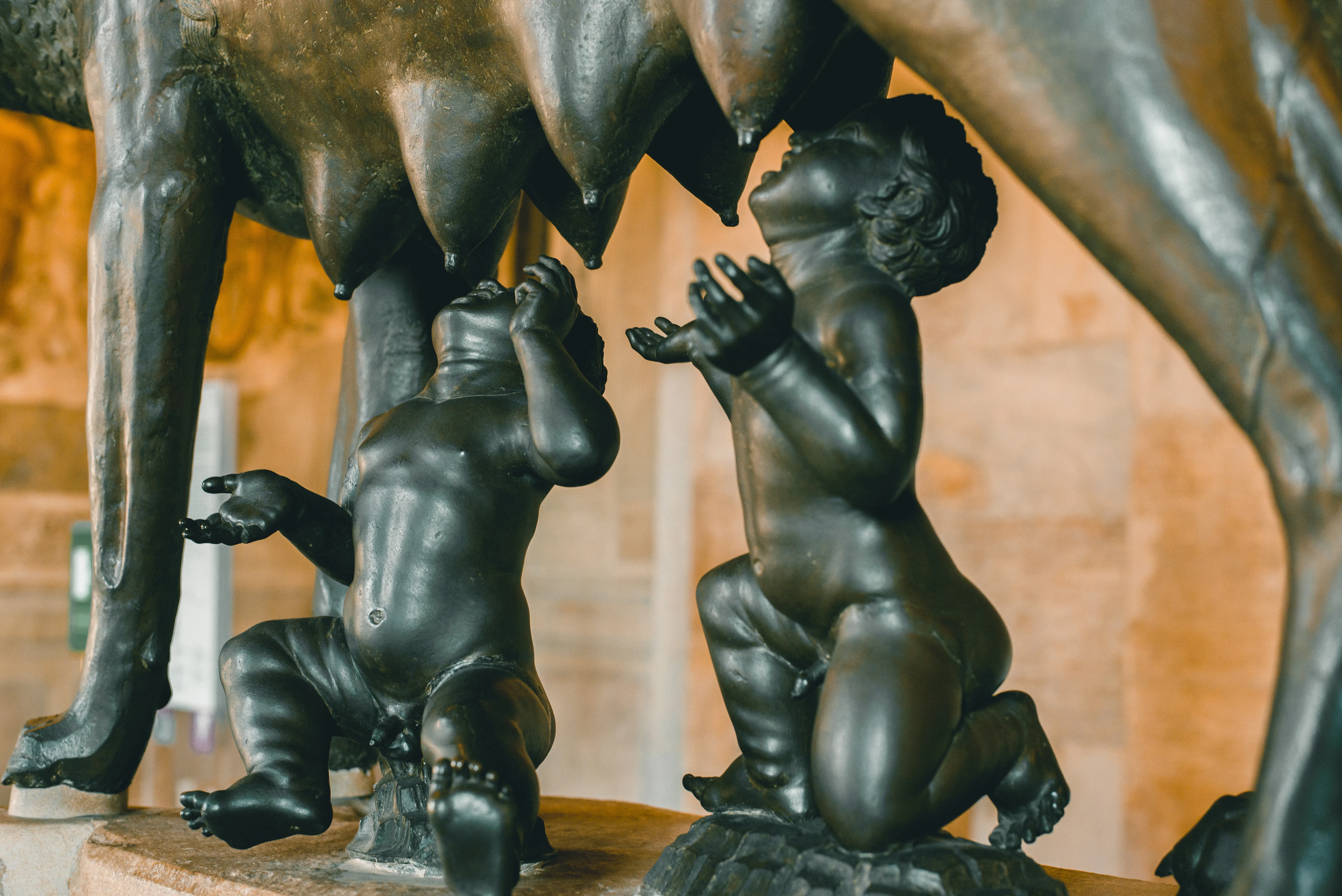
Few objects seem as inseparable from a city as the Capitoline She-wolf is from Rome. The animal stands alert above the twins Romulus and Remus, condensing a foundation myth into a single silhouette. Yet the familiar group was assembled across time, and the date of the wolf remains contested.
The myth behind the image
Roman tradition told that the twins Romulus and Remus, sons of Rhea Silvia and the god Mars, were exposed beside the Tiber. A she-wolf suckled them before the shepherd Faustulus raised them. The brothers later quarrelled, Romulus killed Remus, and Rome took the survivor's name.
Ancient Romans used the wolf-and-twins motif on coins, reliefs and monuments. The story connected the city to divine ancestry, survival and violent foundation.
The bronze on the Capitol
The She-wolf was among the bronzes Pope Sixtus IV gave to the people of Rome in 1471. Its installation on the Capitoline Hill helped make it a civic emblem. The infant twins were added after the transfer and are often associated with a Renaissance workshop, sometimes specifically with Antonio del Pollaiuolo, though the attribution should be stated cautiously.
The group visitors see is therefore not a single ancient conception. Even under the traditional chronology, wolf and twins belong to different periods.
Ancient or medieval?
The museum catalogue retains the traditional attribution of the wolf to the fifth century BC, associating it with an Etruscan or Magna Graecia workshop. That reading made the statue an outstanding survivor from archaic Italy.
Technical observations later challenged the date. Scholars noted that the wolf appears to have been cast as a single piece using a method associated with medieval production. Radiocarbon analysis of organic casting residues has supported a medieval date.
The issue is often reported too simply as a solved scandal. A responsible description should acknowledge the conflict: the official museum record retains an ancient attribution, while published scientific evidence supports medieval casting. Visitors should not present either position as if the other did not exist.
Does a medieval date reduce its importance?
No. If medieval, the bronze becomes an extraordinary example of large-scale metalworking and of medieval Rome's engagement with ancient identity. Its later installation and the addition of the twins still demonstrate how Renaissance civic culture reconstructed the city's past.
The object's symbolic power was created by reception as much as origin. Romans and visitors repeatedly used it to represent the city, regardless of what they believed about its casting date.
How to look at the wolf
Notice the contrast between the animal's tense body and the more decorative treatment of fur. The head turns, ears rise and ribs show, producing vigilance rather than maternal softness. The Renaissance infants below create a different rhythm and anatomy.
Then consider the group as a political image. The twins are vulnerable, but their future city is guaranteed by myth. The wolf is wild, yet she becomes the agent of Rome's survival.
The dating debate should deepen the encounter. The Capitoline Wolf is not a simple illustration from antiquity; it is an object through which ancient myth, medieval craft, Renaissance restoration, modern science and civic identity all compete to define Rome.
L'autore

Editorial Team
Questa guida indipendente è redatta sulla base delle informazioni ufficiali del museo e di fonti culturali autorevoli, distinguendo i dati soggetti a variazione che devono essere ricontrollati.
Tags
Comments (0)
Loading comments...