Palazzo dei Conservatori Highlights and Route
Follow a focused Palazzo dei Conservatori route through civic rooms, famous bronzes, Marcus Aurelius, ancient garden finds, and paintings.
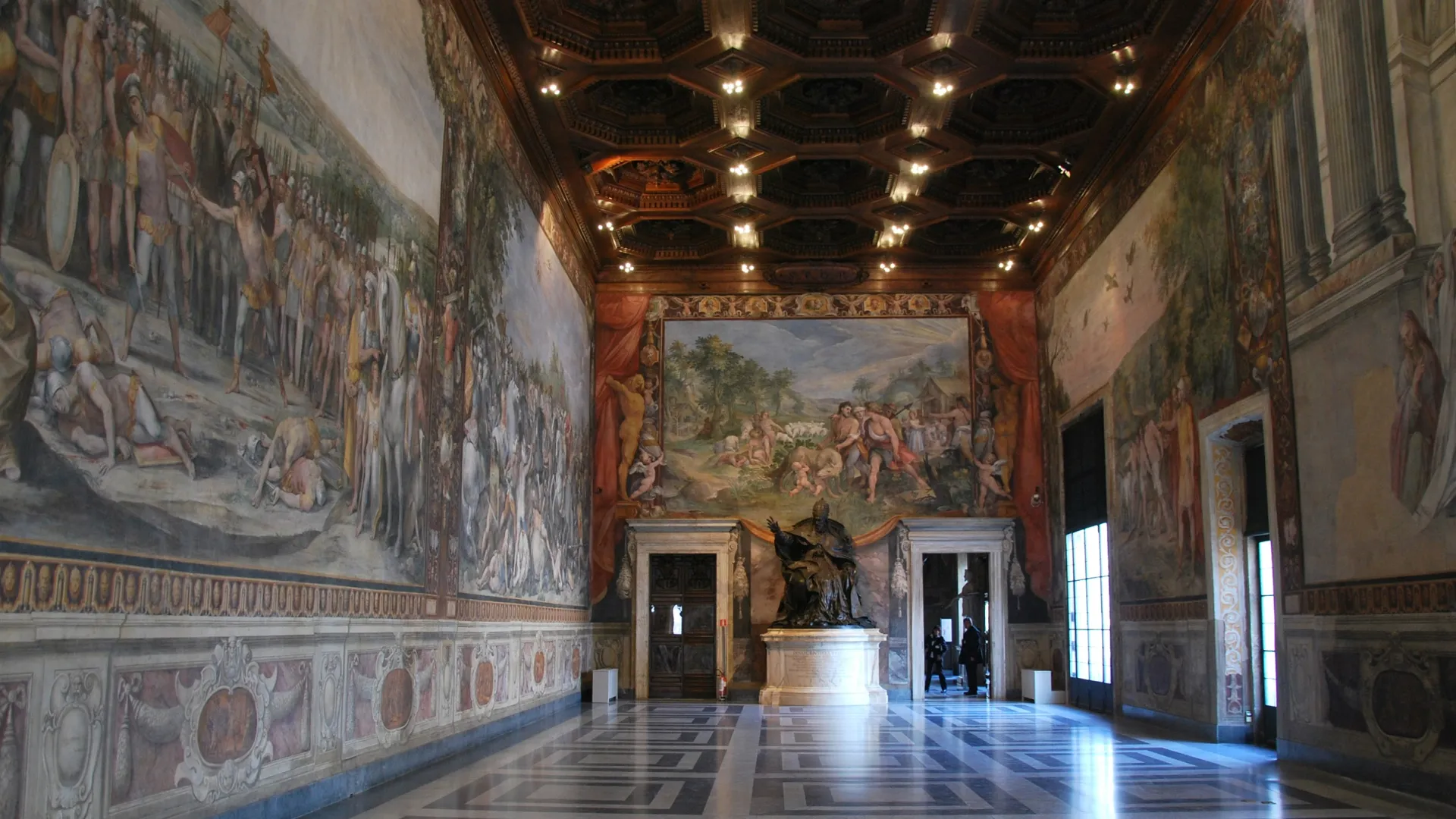
Palazzo dei Conservatori contains the most varied part of the Capitoline Museums. It was a seat of civic magistrates before it became a museum, so decorated state rooms coexist with ancient bronzes, archaeological foundations, classical sculpture and the Pinacoteca.
Courtyard and ancient scale
The courtyard introduces the practice of displaying antiquities on the Capitol. Colossal fragments, reliefs and architectural pieces communicate the scale of Roman public monuments before visitors enter the more intimate rooms above. Look at how ancient material has been incorporated into a Renaissance palace rather than presented in isolation.
The Conservators' Apartments
The historic rooms preserve fresco cycles and civic decoration. They were working spaces of Roman government, not originally neutral galleries. Ancient objects acquired new political meaning when placed here.
The Hall of the Horatii and Curiatii is among the ceremonial high points, while smaller rooms contain several foundational bronzes. The Spinario depicts a seated boy removing a thorn from his foot, combining a Hellenistic body with a head derived from earlier Greek models. Its quiet concentration made it one of the Renaissance's most copied ancient figures.
The Capitoline Brutus is a forceful bronze portrait traditionally linked to Lucius Junius Brutus, though the identification has no firm basis. Nearby, Bernini's Medusa turns a mythic monster into a study of psychological shock and sculptural metamorphosis.
The She-wolf
The Capitoline She-wolf deserves time beyond the inevitable photograph. The twins were added after the bronze reached the Capitol and are often associated with a Renaissance intervention. The wolf's own date remains disputed: the museum maintains a traditional ancient attribution, while scientific analysis of casting residues has supported a medieval date.
That debate makes the object more interesting, not less. Its importance as Rome's civic emblem developed across centuries and does not depend on a single date.
The Exedra of Marcus Aurelius
The route opens dramatically into Carlo Aymonino's glass hall, where the original gilded-bronze equestrian Marcus Aurelius stands protected from outdoor pollution. Walk around it. The emperor's open hand, the horse's controlled movement and traces of gilding are difficult to appreciate from one viewpoint.
The Exedra also exposes the foundations of the Temple of Jupiter Optimus Maximus. This proximity links imperial representation to the oldest sacred centre of the hill.
Sculptures from the Horti
The galleries of ancient garden estates show how elite and imperial residences used sculpture. Commodus as Hercules is the star, but the surrounding works provide essential context. The emperor appears within an elaborate symbolic system, not simply wearing a lion skin.
Check current notices before planning around the Horti of Maecenas, whose rooms may be closed for maintenance.
The Pinacoteca
The painting collection is easy to overlook after so much sculpture. Give it at least thirty minutes. Caravaggio's Fortune Teller turns a street encounter into a subtle drama of attention and deception; his Saint John the Baptist is darker and more ambiguous. Titian, Veronese, Rubens, Guercino and Domenichino broaden the story beyond Rome.
A sensible route
Move from civic rooms to bronzes, then into the Exedra and archaeological galleries. Visit the Pinacoteca before fatigue sets in. Palazzo dei Conservatori works best when read as several museums layered inside one palace: civic seat, antiquities collection, excavation archive and picture gallery.
著者について

Editorial Team
この独立ガイドは美術館の公式情報と信頼できる文化資料に基づき編集し、実用情報の明確さを確認し、変動情報には再確認が必要であることを示しています。
Tags
Comments (0)
Loading comments...