Dying Gaul and Capitoline Venus Compared
Compare Palazzo Nuovo's Dying Gaul and Capitoline Venus through pose, identity, vulnerability, ancient prototypes, and museum display.
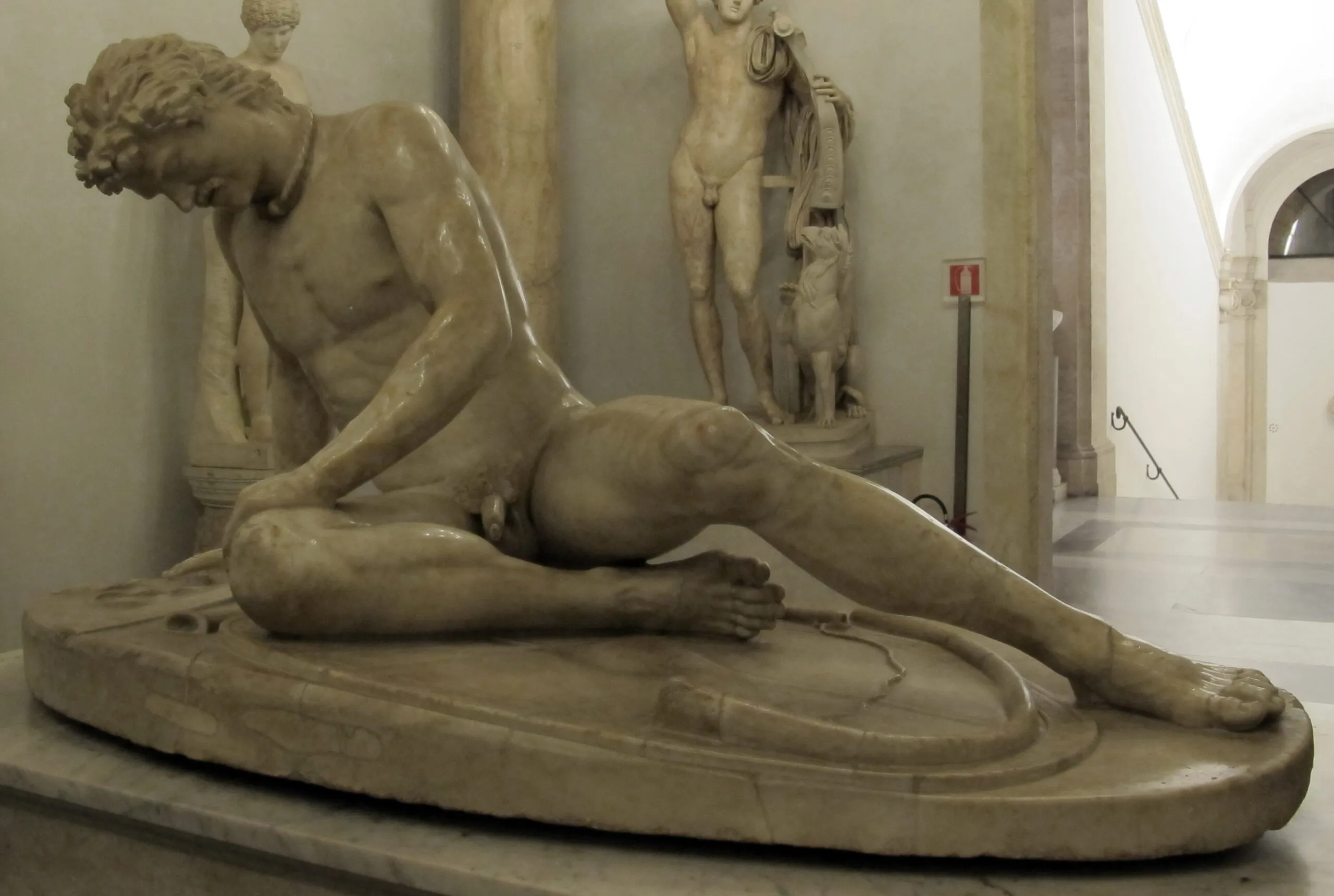
The Dying Gaul and Capitoline Venus occupy separate rooms in Palazzo Nuovo and represent very different bodies: a wounded foreign warrior collapsing after battle and a goddess surprised in a moment of nudity. Together they show how classical sculpture constructed identity through pose and how later museums turned ancient marbles into universal icons.
The defeated warrior
The Dying Gaul is a Roman marble carved around the first century BC and based on a Hellenistic work associated with the victories of Attalus I of Pergamon over the Galatians. Ancient viewers could identify the subject as foreign through his torc, moustache, hair and equipment.
The sculpture celebrates victory, but it does not make the enemy ridiculous. The warrior supports himself with one arm as strength drains from his body. His wound and downward gaze make defeat physically present. Dignity heightens the victor's achievement: only a formidable opponent can produce a meaningful triumph.
Walk around the statue. The composition unfolds in space, and the relation between torso, supporting arm, shield and ground cannot be understood from the standard frontal photograph.
The goddess in an intimate room
The Capitoline Venus is a Roman marble derived from a Greek fourth-century-BC model associated with the Praxitelean tradition. Found near San Vitale around 1666–1670, it entered the Capitoline collection and became one of its most celebrated works.
The goddess draws her arms across her body in the type known as Venus Pudica, or modest Venus. The label can be misleading if it suggests simple embarrassment. The gesture conceals and directs attention at the same time, while the body's turn creates a carefully controlled sequence of viewpoints.
Palazzo Nuovo's octagonal cabinet intensifies the encounter. Architecture gives the statue a private visual field, separating it from the crowded portrait galleries nearby.
Vulnerability constructed for different purposes
Both figures appear vulnerable, but their vulnerability operates differently. The Gaul's wound narrates political defeat. His ethnic markers make him a named type within a victory monument. Venus's exposed body belongs to myth, beauty and the viewer's movement; her gesture stages awareness of being seen.
Neither work is a transparent record of a real person. Each uses anatomy, pose and attribute to produce a cultural meaning.
Roman copies and Greek originals
Both sculptures complicate the language of originality. Roman patrons valued Greek artistic forms and commissioned versions, adaptations and copies. The surviving marble may preserve knowledge of a lost Greek bronze or celebrated prototype while also being a Roman object with its own material and historical life.
Calling the works copies should not imply mechanical reproduction. Scale, marble technique, setting and patronage could alter the effect of a model substantially.
Their later fame
Artists and travellers studied both statues for centuries. Casts, engravings and written descriptions spread their reputations far beyond Rome. They helped define European ideas of heroic pathos and ideal beauty.
See them after visiting the Hall of the Emperors. The contrast is useful: portrait busts construct individual and dynastic identity through faces, while the Gaul and Venus make the entire body carry narrative and cultural meaning.
Their fame is justified, but attentive viewing restores complexity. One is not merely a sad soldier, and the other is not merely an ideal nude. Each is a carefully staged encounter between body, identity, viewer and power.
เกี่ยวกับผู้เขียน

Editorial Team
คู่มืออิสระนี้เรียบเรียงจากข้อมูลอย่างเป็นทางการของพิพิธภัณฑ์และแหล่งข้อมูลวัฒนธรรมที่น่าเชื่อถือ โดยทบทวนข้อมูลการใช้งานให้ชัดเจนและระบุข้อมูลที่ควรตรวจสอบซ้ำเพราะอาจเปลี่ยนแปลงได้
Tags
Comments (0)
Loading comments...