Palazzo Nuovo Guide: Capitoline Sculpture Highlights
Tour Palazzo Nuovo's historic rooms and see the Dying Gaul, Capitoline Venus, Marforio, philosophers, and imperial portraits.
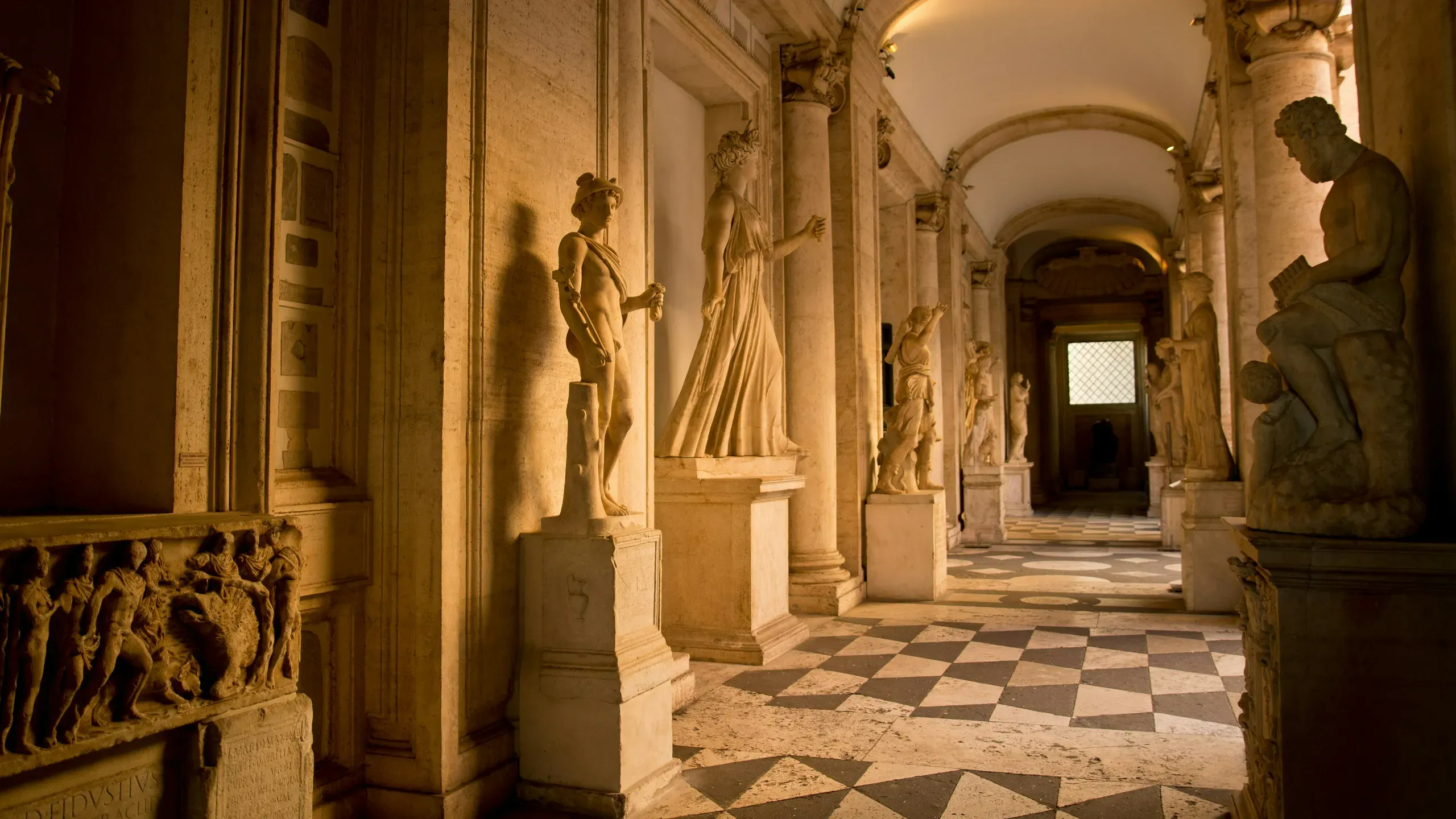
Palazzo Nuovo offers one of Europe's clearest encounters with the early public museum of classical sculpture. Its decorated rooms, dense arrangement and gilded ceilings preserve much of the character established after the palace opened to visitors in 1734.
A palace created to complete the square
The building was constructed in the seventeenth century by Girolamo and Carlo Rainaldi, following the broad concept Michelangelo had established for Piazza del Campidoglio. Its façade mirrors Palazzo dei Conservatori across the square, but its interior developed around the display of antiquities.
The acquisition of Cardinal Alessandro Albani's collection in 1733 supplied the institutional turning point. Hundreds of sculptures could be organised as a public study collection rather than dispersed through a private residence.
Courtyard and Marforio
The colossal Marforio dominates the courtyard fountain. Interpreted as a river or Oceanus figure, it was moved to the Capitol in the late sixteenth century. It is also one of Rome's six talking statues, figures on which anonymous satirical verses were traditionally posted.
Its scale is a reminder that many museum objects once belonged to architectural ensembles and public spaces. Marforio was not conceived as a freestanding gallery sculpture.
Portraits as political language
The Halls of the Emperors and Philosophers place rows of busts in visual dialogue. Roman portraiture communicated age, military authority, dynastic legitimacy and intellectual identity through carefully controlled hair, facial expression and costume.
Do not try to memorise every name. Compare the polished idealism of one dynasty with the beard, drilled hair or stern realism of another. The gallery becomes a visual history of how power wanted to be seen.
The Capitoline Venus
The nearly two-metre marble Venus occupies an octagonal cabinet designed to intensify an intimate viewing experience. Found near San Vitale in the seventeenth century, the statue derives from a fourth-century-BC Greek type associated with Praxiteles.
Her gesture belongs to the so-called modest Venus tradition, but the work is not simply shy. The turn of the body creates a changing silhouette as the viewer moves, making the cabinet part of the sculpture's presentation.
The Dying Gaul
The Dying Gaul is a Roman marble related to a Pergamene victory monument celebrating defeat of the Galatians. The torc, moustache and hair identify the warrior as a foreign enemy to ancient viewers. Yet the sculpture grants him physical dignity and emotional presence.
Walk around the figure if circulation permits. From the front, the composition appears self-contained; from the side, the body's collapse and the effort of the supporting arm become more apparent.
Access and route cautions
Palazzo Nuovo's historic structure can make accessibility vulnerable to maintenance. Current restoration has at times prevented wheelchair access to the building because the route to its lift was affected. Verify the latest official notice rather than assuming every gallery is reachable.
For other visitors, allow forty-five to seventy-five minutes. The palace rewards slow comparison more than checklist touring. Its significance lies not only in individual masterpieces but in the survival of an eighteenth-century idea: antiquity ordered into rooms so that a public could learn by looking across objects.
Про автора

Editorial Team
Незалежний путівник створено за офіційною інформацією й авторитетними культурними джерелами; практичні дані перевірено на ясність, часові позначено для повторної перевірки.
Tags
Comments (0)
Loading comments...