Michelangelo's Piazza del Campidoglio Explained
Read Michelangelo's Piazza del Campidoglio through its trapezoidal plan, palace façades, cordonata, Marcus Aurelius, and star pavement.
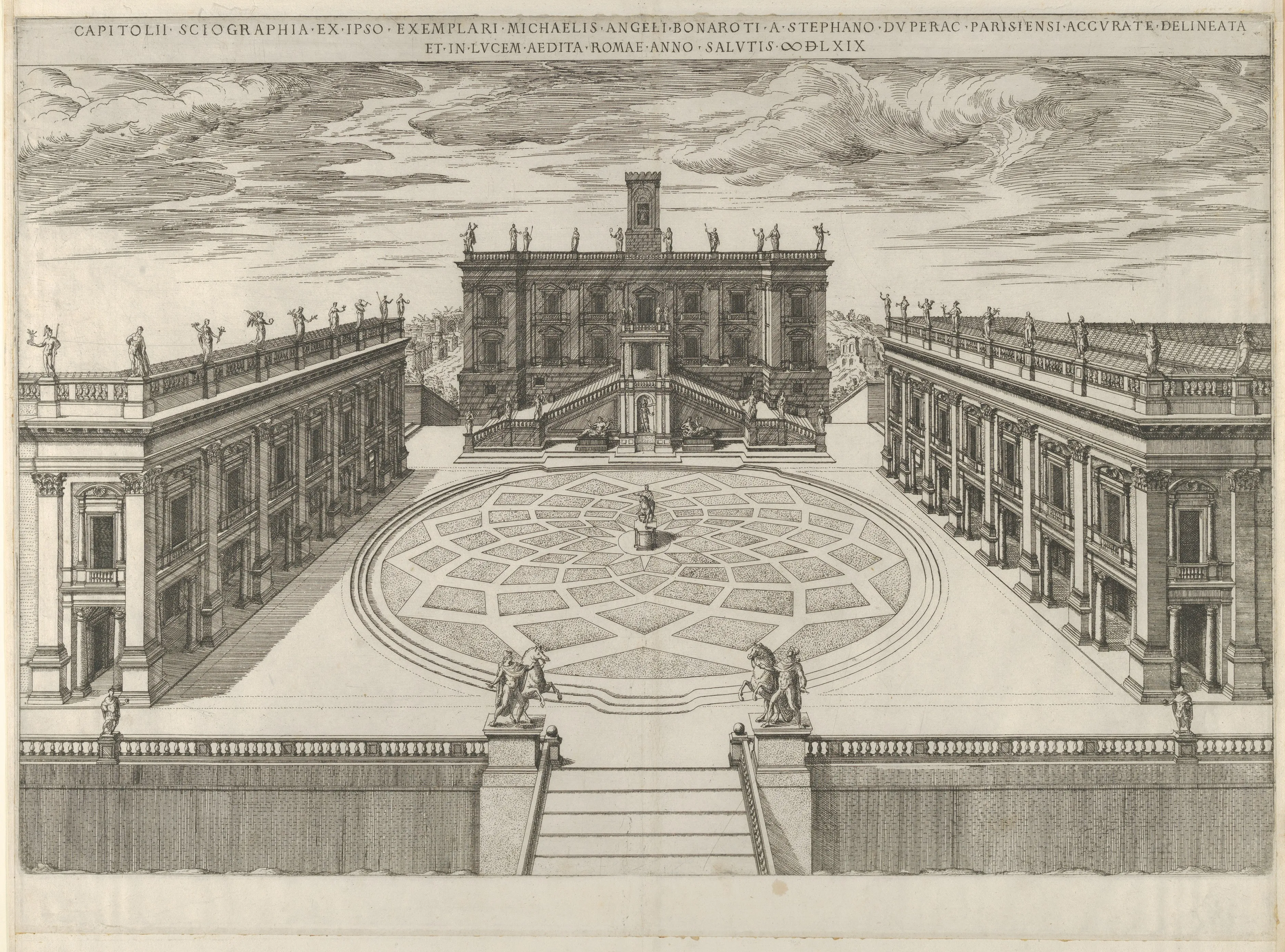
Piazza del Campidoglio is one of Rome's most controlled urban spaces, yet almost nothing about its history was completed in a single campaign. Michelangelo supplied the governing idea; later architects interpreted it over generations; the famous star pavement arrived only in the twentieth century.
Turning the hill toward modern Rome
The ancient Capitoline had faced the Forum, the political centre below its eastern slope. By the sixteenth century, the summit held medieval civic buildings and an irregular open space. Pope Paul III commissioned Michelangelo to reshape the setting in the years around 1537.
Michelangelo redirected the composition toward the expanding modern city and the Vatican side of Rome. Visitors now approach from Piazza Venezia along the cordonata, entering a ceremonial space framed by three palaces. This reorientation was both practical and symbolic: papal Rome presented itself as heir to ancient civic authority.
A trapezoid that reads as harmony
The piazza is not a simple rectangle. Palazzo dei Conservatori and Palazzo Nuovo diverge slightly, creating a trapezoid. Michelangelo used the geometry rather than hiding it. The angled façades draw attention toward Palazzo Senatorio, while the oval pavement organises the open centre.
The design demonstrates how architecture can create visual order without perfect symmetry. Palazzo Nuovo mirrors the Conservatori externally, but the two buildings have different histories and interiors. Their paired façades make the piazza feel intentional and balanced.
The giant order
On Palazzo dei Conservatori, colossal Corinthian pilasters rise through more than one storey. Smaller columns define the ground-level portico, setting up a hierarchy between human scale and civic monumentality. High pedestals, strong cornices and repeated bays give the elevation a measured rhythm.
Michelangelo died before the programme was complete. Giacomo della Porta and other architects adapted his designs, while Girolamo and Carlo Rainaldi developed Palazzo Nuovo in the seventeenth century. The result is not a frozen autograph work but a long architectural conversation with Michelangelo's concept.
Marcus Aurelius at the centre
The ancient equestrian bronze was moved from the Lateran to the Capitol in 1538. Its placement made the emperor the pivot of the new square. The statue survived the Middle Ages partly because it was mistaken for Constantine, the first Christian emperor.
The outdoor figure seen today is a replica. Conservation concerns led to the original being installed in the museum's glass Exedra. This separation creates a useful double encounter: the copy explains the urban composition, while the original reveals the bronze's scale, surviving gilding and remarkable technical presence.
The pavement completed centuries later
Michelangelo's oval and radiating pattern is one of the square's most recognisable features, but it was executed only in 1940. Its interlaced forms gather the irregular space around the central statue and make the piazza appear like a designed surface rather than leftover ground between buildings.
How to look at the piazza
Pause first at the top of the cordonata. Notice how the palaces frame rather than block the sky. Walk around the Marcus Aurelius replica and watch the trapezoid change. Then compare the exterior order with the internal courtyards and galleries.
The square's achievement is not decorative uniformity. It is the transformation of buildings from different periods into a civic stage where ancient sculpture, papal ambition and municipal government remain visibly connected.
关于作者

Editorial Team
本独立指南依据博物馆官方信息和权威文化来源编辑,实用信息经过清晰性审核,并标明需要复核的时效性内容。
Tags
Comments (0)
Loading comments...