Equestrian Marcus Aurelius: Capitoline Bronze Guide
Learn why the gilded-bronze Marcus Aurelius survived, how it communicates imperial authority, and why the original now stands indoors.
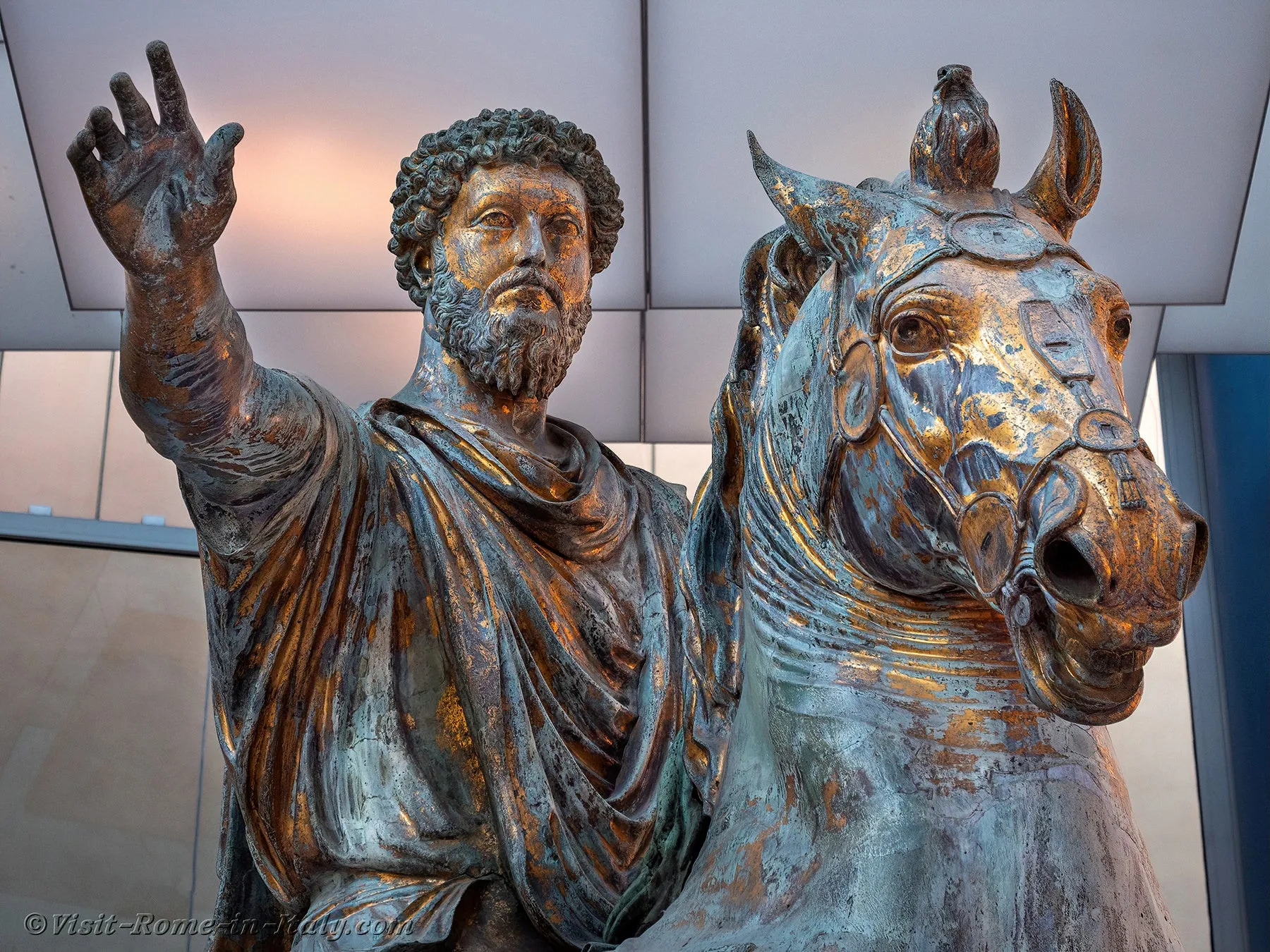
The equestrian statue of Marcus Aurelius is exceptional before any interpretation begins. Monumental bronze statues filled Roman public spaces, but their metal was valuable and most were eventually broken up and melted. This work, created between AD 161 and 180, is the only substantially surviving ancient Roman example of its monumental equestrian type.
Why did it survive?
For centuries the rider was believed to be Constantine, the emperor associated with Christianity's imperial acceptance. That mistaken identity probably protected the statue from destruction. It stood near the Lateran Palace before Pope Paul III ordered its transfer to the Capitoline Hill in 1538.
Michelangelo made the bronze the centre of his new Piazza del Campidoglio. The placement converted an ancient imperial image into the pivot of Renaissance Rome's civic stage.
Reading emperor and horse
Marcus Aurelius raises one hand in a gesture that can suggest address, clemency or controlled authority. He carries no visible weapon. The horse is energetic but mastered, and the rider's scale and composure dominate the composition.
The statue may once have included a defeated figure beneath the horse's raised hoof, although reconstructions remain hypothetical. Even without that element, power is communicated through balance: movement never becomes disorder.
Walk around the sculpture in the Exedra. From the front it has ceremonial directness; from the side, the horse's musculature and the emperor's seated weight become clearer. The rear view reveals technical and compositional decisions hidden in most photographs.
Surface, casting and gilding
At 4.24 metres high, the statue required sophisticated large-scale bronze casting and assembly. Surviving gold on the surface hints at its original brilliance. In antiquity, the visual effect would have been very different from the dark green-brown colour now associated with ancient bronze.
This matters because Roman sculpture was rarely the bare stone or muted metal imagined by later taste. Colour, gilding and architectural setting shaped the encounter.
Original and replica
The figure at the centre of Piazza del Campidoglio is a replica. After conservation concerns, the ancient bronze was removed from outdoor exposure and installed inside Carlo Aymonino's glass Exedra.
The change preserves the object but divides its meanings. Outside, the replica completes Michelangelo's urban composition. Inside, controlled conditions allow close inspection of the original surface and surviving gilding. Visitors should see both.
The philosopher-emperor problem
Marcus Aurelius is widely remembered through his philosophical writings, but the statue should not be reduced to a portrait of private reflection. It is an official imperial monument. Its controlled gesture, heroic scale and mounted format announce public authority.
The tension between later reputation and ancient political image is part of its fascination. The man who wrote about self-discipline is presented through one of Rome's most commanding visual forms.
A work that shaped later monuments
Renaissance and later rulers repeatedly adopted the equestrian statue as a language of sovereignty. The Capitoline bronze offered artists an ancient model for the relationship between rider, horse, pedestal and public square.
Its survival therefore altered European art history. It did not merely preserve one Roman emperor's likeness; it provided a durable template for how political power could occupy urban space.
关于作者

Editorial Team
本独立指南依据博物馆官方信息和权威文化来源编辑,实用信息经过清晰性审核,并标明需要复核的时效性内容。
Tags
Comments (0)
Loading comments...